Search
Showing 10 of 7355 results
-
Tokyo teachers learn from New Zealand
The workshop was hosted by ENZ in collaboration with the Tokyo Metropolitan Board of Education, and facilitated by Dr Howard Youngs, Director of Auckland University of Technology (AUT) School of Education.
Misa Kitaoka, ENZ’s Senior Market Development Manager – Japan, said the interactive workshop on key values, social competencies and learning areas based on the New Zealand Curriculum, was a valuable experience for participating teachers.
“The most popular exercise among the teachers was the pepeha, where they introduced themselves by speaking in te reo Māori for the first time. The experience helped the teachers relate to and better understand their students who may not be native Japanese speakers.”
The workshop was particularly relevant to today’s Tokyo schools which are becoming increasingly diverse in terms of ethnicity and language, Misa said. This was particularly the case with the launch of the Tokyo Board of Education’s ‘Diverse Link Tokyo Edu’, a new learning initiative to promote inquiry-based learning with overseas institutions and organisations.
“I look forward to working with New Zealand providers to showcase the Kiwi classroom experience, and the way it highlights the uniqueness of the New Zealand curriculum, to complement our student recruitment work.”
Held in the last week of April, the workshop was also a way to acknowledge Japan’s new Reiwa era, which began on 1 May after Emperor Naruhito ascended the Chrysanthemum throne.
“Hosting an event around a new imperial era is of enormous significance in Japan, and Reiwa (which means beautiful harmony in Japanese) is said to reset the national mood,” Misa said.
Dr Youngs’ innovative workshop was featured in Japanese media, including Yomiuri Shimbun, one of Japan’s largest national newspapers.
Tokyo Metropolitan Board of Education’s Director of International Education, Ms Akiko Mori, said the workshop was a wonderful opportunity for Tokyo teachers to get a taste of the latest pedagogy from a New Zealand university through the board’s partnership with Education New Zealand.
“I have received great feedback from the participants and look forward to promoting more opportunities like this as part of the Diverse Link Tokyo Edu initiative,” she said.
Ms Mori will be speaking at the upcoming NZIEC to introduce new initiatives by the Tokyo Government to promote international education, global talent and leadership in Japan.
- 2122 159 Attachment 1 ENZ Broader Impact Valuation Valuation Report
-
Journey around the world with the NZIEC Quiz!
Join us to take a swift journey around the world, and our industry, in this inaugural quiz. Jules Verne had 80 days to circle the world – NZIEC delegates will have 40 questions.
Sam Mackay, ENZ Strategic Projects Manager, said the quiz format is designed to energise and engage delegates at the end of a long conference day.
“Through four rounds, we’ll be challenging your knowledge of our international education industry.
Amy Rutherford, ENZ’s North America Director said delegates may be surprised at what they learn.
“Sam and I have spent a lot of time searching our brains – and the internet – for interesting international education-related questions,” she said.
The rapid fire quiz will be held in the last breakout session of Day 1. Turn up on the day and you'll be assigned to teams.
Prove your international education expertise, and be in to win some special prizes – and bragging rights!
Register now at www.nziec.co.nz
-
Successful Brazil media famil
Media familiarisation trips are a great way for journalists from our key markets to develop a better understanding of New Zealand’s education system, possible study options, and the experiences of international students.
The journalists received a warm welcome from education providers in Wellington, Canterbury, Hawke's Bay and Auckland – thank you very much to everyone involved. Special thanks also to our regional education partners, especially Brook Pannell (Wellington), Bree Loverich (Canterbury), Steph Kennard (Hawke’s Bay) and Nick Arnott (Auckland).

Sylvia Santos, Maths Tutor at Ara, brought the journalists home-baked Pão de Queijo (Brazilian Cheese Bread)
There were around 3,000 Brazilian students in New Zealand in 2015, and on this trip the journalists met Brazilian students and staff everywhere they went – which was a great way to build relationships and showcase the opportunities for students here.
The famil is a long-term investment in promoting international education – but two very positive articles have already been published by Camila on Exame.com, the online content and news portal of Exame Magazine, which is the largest and most influential business and economy publication in Brazil:
Esta é a cidade da Nova Zelândia mais promissora para engenheiros (This is the most promising city for engineers)
A Nova Zelândia quer atrair mais profissionais de tecnologia (New Zealand wants to attract more technology professionals)

Lyn Garrett, Senior Lecturer and Major Coordinator for Industrial Design at Massey Wellington with Camila and Luiza in the workshop

The new Engineering Core at University of Canterbury displayed a special welcome sign for the group

Julia Kowalski, international student from Brazil, and Charlotte Taurima-Thomas, Head of Māori Students, showing the journalists how to hongi during a powhiri at Taradale High School.

Camila, Luiza, Steph Kennard and Tales prepare for a brief wine tasting at EIT

Luiza chats with Brazilian students Susana do Nascimento and Rene Souza, hosted by ATEED
-
Korea and New Zealand sign historic agreement
On 23rd February, New Zealand hosted a Korea-New Zealand education Joint Working Group (JWG) in Wellington, where a delegation of Korean education officials met with officials from the Ministry of Education (MOE), the New Zealand Qualifications Authority (NZQA) and ENZ to exchange policy updates and sign a Joint Recognition Statement – a landmark document regarding senior secondary school qualifications in both countries.
The statement follows the Comparison of Senior Secondary School Qualifications, a joint research report which concluded that the Korean High School Certificate and the New Zealand National Certificate of Educational Achievement Level 3 are broadly comparable.
New Zealand Secretary of Education Iona Holsted said the signing of the statement will support higher education institutions in both countries to make decisions about these qualifications, with the potential to open up study opportunities for young Kiwis and Koreans.
“The joint statement is a step towards our students being able to have previous qualifications more easily recognised abroad and will provide access to further study that has traditionally been difficult to access.
“While there is still more to do, I’m looking forward to seeing the shared benefits for both countries,” Ms Holsted said.
NZQA Chief Executive Dr Karen Poutasi said the Recognition Statement and research report are a result of the two countries’ collaborative work under the Education Cooperation Arrangement, signed in 2009.
“The statement is the first of its kind signed by Korea and is a sign of confidence in the quality of education in both countries,” said Dr Poutasi.
“The joint research report has helped to promote a shared understanding of the Republic of Korea and New Zealand’s education systems and curricula. We look forward to further dialogue between our two countries.”
Poutasi now hopes to see more Korean students coming to study in New Zealand, and vice versa.
- japan
-
International Student Research Community
Share your experience. Help shape the future of studying in New Zealand.
The International Student Research Community is a group of prospective, current, and former international students who share their views and experiences of studying with New Zealand education providers. It is run by Education New Zealand Manapou ki te Ao (ENZ), the New Zealand government agency responsible for promoting international education and supporting student experiences.
Your feedback helps shape decisions, services and experiences for future students.
About the community
Members are invited to share insights across the student journey – from choosing where to study through to life after study. These insights help shape policies, services, and initiatives across the sector.
Why join
- Have your voice heard and help improve the international student experience
- Influence decisions that affect future students
- Take part in research in a flexible way that suits you
- Receive incentives as a thank you for your time
How it works
- Sign up to join the community
- Get invited to participate in surveys, interviews or focus groups
- Take part in research in a flexible way that suits you
- Receive incentives as a thank you for your time
What to expect
Frequency
This varies depending on what’s happening in the sector. Typically, you can expect to participate in a few short surveys each year, with occasional opportunities to join discussions or share feedback on specific topics. Participation is always voluntary and you can choose which invitations to accept.
Time commitment
Most surveys take 5 to 15 minutes to complete. Some activities, such as focus groups or interviews may take longer – but we’ll always let you know what’s involved up front.
Benefits of taking part
There may be prize draws or gift vouchers, depending on the activity. Details of any incentive will be included in your invitation to participate.
You’ll also have the opportunity to make a real difference by helping shape important decisions around international education for New Zealand.
Privacy and confidentiality
Your responses will be combined with others and analysed to identify overall trends and insights. Results are reported in a way that does not identify individuals.
All personal information is kept secure and confidential, in line with privacy requirements.
Join the Community
We’re not accepting new sign-ups just yet. Check back soon for details on how to join the Community.
Leaving the Community
You can leave by using the unsubscribe link in any of our emails, or by emailing us at researchcommunity@enz.govt.nz.
About ENZ
ENZ is a New Zealand government agency. We promote New Zealand as a study destination and work to ensure international students have a high-quality education and experience.
-
Summer in Aotearoa New Zealand – Explore, have fun and stay safe!
Education New Zealand Manapou ki te Ao (ENZ) is supporting students to explore New Zealand this summer with an emphasis on staying safe during their holiday break.
NauMai NZ has dedicated pages on outdoor safety, water safety, road safety and the New Zealand climate, supporting students to prepare for their activities over the summer. NauMai NZ also has information on the cities and regions of New Zealand, along with recommendations of things to do and see and how to get there.
ENZ reminds students to keep themselves safe from scams. If students have lost money in a scam or have been the victim of an online scam where threats have been made against them, they can contact the NZ Police who are here to help. Phone 105 or report online.
Summer is a great opportunity to take a break from study and find time to relax and explore our beautiful country. There is plenty to see and do in New Zealand but students can also take steps to stay safe, wherever they are and whatever they are doing. NauMai NZ is here to help them.
Happy summer holidays!
-
50 Malaysian educators experience New Zealand’s interactive early childhood education
On 9-10 May 2024, Education New Zealand Manapou ki te Ao (ENZ), the Ministry of Education Malaysia, and the University of Auckland co-hosted a two-day workshop for Malaysian educators. The theme of the workshop was "Engage, Explore, Excel: Interactive Play Strategies for Effective Preschool Education".
The workshop gave approximately 50 Malaysian preschool educators the opportunity to see and experience for themselves some of New Zealand’s innovative and interactive approaches to education that start in early childhood education facilities. The workshop was also an opportunity to strengthen bilateral ties between our two countries.
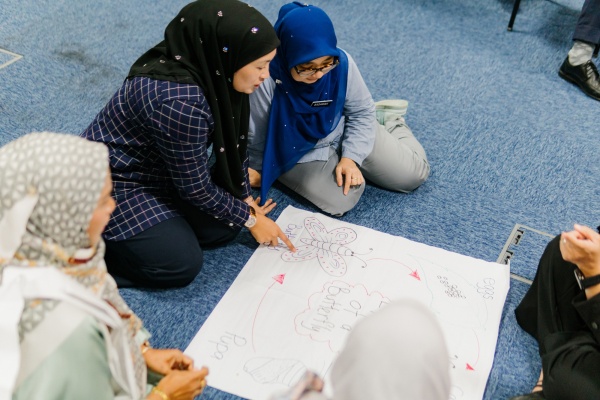
Workshop participants discussing learning techniques used in New Zealand early childhood institutions.
Professor Marek Tesar, a distinguished early childhood education expert from the University of Auckland led the workshop and shared his expertise with the group. He highlighted innovative approaches to implementing interactive outdoor play and used practical insights with theoretical foundations to enhance the educators' skills and knowledge. This included leading the group through experiential activities and thought-provoking discussions, including how outdoor play can instil a sense of environmental stewardship among teachers and children.

Malaysian early childhood educators at the workshop on "Engage, Explore, Excel: Interactive Play Strategies for Effective Preschool Education".
Ben Burrowes, ENZ’s Regional Director Asia (excluding China) and Acting General Manager International, and Emma Verry from the New Zealand High Commission in Kuala Lumpur attended the session and extended warm welcome remarks, underscoring the importance of international collaboration in advancing early childhood education in both countries.

From left to right: ENZ’s Ben Burrowes, Juraida Binti Umat Bidin, Deputy Director of Preschool Sector Curriculum Development Division and Nooraini Binti Kamaruddin, Senior Deputy Director Curriculum Development Division from the Ministry of Education Malaysia, Emma Verry from the New Zealand High Commission, ENZ’s Market Manager for Indonesia and Malaysia Naluri Bella, and University of Auckland’s Professor Marek Tesar. They are pictured here after the exchange of commemorative gifts in recognition of the occasion.
Ben said that the workshop gave a wonderful opportunity for educators from Malaysia to come together to hear from Professor Tesar and explore the multifaceted benefits of interactive play.
“Our two countries recognise the critical importance of the formative years in a child’s development and the profound impact that quality early childhood education can have on their future success and well-being.
“Participants were all very enthusiastic about discovering new ways to engage and empower their students. We hope this will lead to more collaboration and sharing of ideas between our two countries that educators and students alike can benefit from,” said Ben.
-
Education diplomacy strengthens New Zealand’s relationship with the Pacific Alliance
This initiative, funded by Education New Zealand Manapou ki te Ao, is a significant milestone in the relationship between New Zealand the alliance.
At the graduation ceremony, New Zealand Ambassador to Chile, Linda Te Puni, said “this celebration today is, first and foremost, yours but it is also a milestone for New Zealand because it reaffirms our commitment to the Pacific Alliance. We are pleased to continue to build and strengthen this relationship in various areas, including networking, educational and between peoples.”
The Pacific Alliance is a Latin American free trade area and economic integration initiative, established by Chile, Colombia, Mexico, and Peru in 2011. The bloc comprises the world’s eighth-largest economy and is home to over 220 million people. It has been identified by the Ministry of Foreign Affairs and Trade as a priority region for New Zealand, with negotiations for a free trade agreement currently underway.
The objective of the English Network of the Pacific Alliance is to develop a cooperation strategy to improve the language in the bloc, work in which it has had the support of New Zealand as an observer country.
“The promotion of the English language expands our people’s access to educational, scientific, technological and employment opportunities, while contributing to the formation of a more productive workforce, with a view to strengthening our competitiveness in global arenas,” Director of Regional Coordination and Integration Mechanisms of the Ministry of Foreign Affairs of Colombia and National Coordinator of Colombia for the Pacific Alliance, Adela Maestre, said.
The Pacific Alliance version of the NZGCC was led by teachers from Massey University. The first four weeks of the course were dedicated to the certificate, while the last two focused on creating a ‘community of learning’ for support and guidance, where methodologies, teaching practices and resources can be shared well after the course has finished.
The NZGCC was originally designed by AFS. The certificate teaches self-awareness, empathy for other cultures, and ways to build bridges in multicultural settings.