
Search
Showing 10 of 7355 results
-
Lifeswap premiere celebrates friendship between New Zealand and Germany
The final two episodes of the cult-hit webseries Lifeswap, ‘Laughing Matters’ and ‘Die Brücke’, concluded the animated adventures of Duncan and Jörg – the German and Kiwi friends who helped one another understand a new culture.
‘Laughing Matters’ tells the story of Jörg, who had an excellent experience in New Zealand, and (due to his preparedness for the future) was accepted into one of New Zealand’s most innovative and technologically advanced companies ‘Rockets R Us’.
The episodes were commissioned by ENZ and the Germany Embassy respectively.
“We were very fortunate to be able to celebrate Lifeswap with its creators Steffen Kreft – who was himself an international student at Massey University in Wellington – and William Connor, and their many fans at a live event at Wellington’s Embassy Theatre,” ENZ Chief Executive Grant McPherson said.
“After a year of restricted international travel and very few in-person events, it was a reminder that global education connection and cooperation has not stopped.
“The Lifeswap series highlights how the longstanding friendship between New Zealand and Germany transcends the situation we find ourselves in. It is a very powerful example of international education relationships keeping New Zealand globally connected while travel is limited.”
Following the launch of Laughing Matters – which built on the success of the first joint ENZ Lifeswap episode Group Effort in which Prime Minister Jacinda Ardern had a cameo appearance – the partnership is also being shared with key partners and audiences in Germany as part of ENZ's Americas, Middle East and Europe Education Week.
To leverage the popularity of the new episode and the wealth of the important topics it deals with, ENZ is working with a PR agency in Germany to tell this positive story more widely.
The PR engagement will involve a mix of approaches, including traditional media, social media and partnering with influencers, to ensure we reach a wide audience on all relevant channels.ENZ General Manager – International, Lisa Futschekworked with Kreft and Connor for months on ‘Laughing Matters’.
“It’s a great fit for Education New Zealand to be working with such creative people who are telling a fantastic story about the friendship between New Zealand and Germany.”
Also in attendance was the German Ambassador to New Zealand, his Excellency Stefan Krawielicki.
In his speech to the audience, the Ambassador noted how the humour of Lifeswap allows New Zealanders and Germans to laugh at themselves, and understand our differences.
“It’s such an enriching experience for young people to go to New Zealand – or for young people to go to Germany – and learn about different approaches and shared values,” he said.
“Education is a bridge builder and makes young people [become] lifelong ambassadors.”
Lifeswap dates back to 2013, when creators and partners Kreft and Connor began to work together, pooling their considerable skills in language, animation, and cultural competency.
The pair said at the premiere that while they’re sad to leave Duncan and Jörg behind, their story is complete.
“It’s probably a little bit like what parents feel like when their kids are going to study overseas,” Kreft says.
- EEL Annual Report 2023
-
Around the world in five
Australia
Scott Morrison prepares to let in over 200,000 students and skilled workers
Japan
Travel ban lifted but students could be a long time coming
United States
68% increase in new first-time international enrolments across the United States
Global
Agent views of Australia/New Zealand drop as United Kingdom, Canada and United States benefit
United Arab Emirates
-
Get tips and tools at ENZ’s Seminar Series
The seminars are being held in mid-March in six locations around the country. The morning and afternoon seminars are self-contained so you can opt to attend one or both. And, you can eat your lunch while watching the launch of the New Zealand School Story!
Each seminar will be limited to 40 participants so be quick off the mark to register.
Please register separately for each session, including the lunchtime launch.
Register online here.
Seminar details
Seminar 1 (9.30am- 11.30am): Personas: Understanding your Audience
Knowing how your audience think and behave is the most important step in connecting with them. In this session ENZ’s General Manager of Marketing and Channel development, Paul Irwin, and International Brand Manager, Kaylee Butters, will share the New Zealand International Student Personas, which were developed as part of a global research project. We'll introduce you to tools you can use to improve your student recruitment and student experience.
Morning tea will be provided.
Lunchtime session
Launching the New Zealand School Story (12noon – 1.00pm)
In this lunchtime session we will launch the New Zealand School Story. We'll take you on the journey from the planning through to the development of the final suite of resources – all of which will be available on The Brand Lab. We’ll also suggest ideas as to how you can use this story in your own international marketing activity.
Bring your own lunch – coffee and tea will be provided.
Seminar 2 (1.30pm- 4.30pm): Creating Effective Digital Marketing Programmes
Led by the ENZ digital marketing team, this interactive session will focus on the basics of digital marketing. We'll show you how to develop an effective programme from strategy to set-up, through to launch, evaluation and optimisation. We'll help you to decide where to focus your efforts, using case studies from ENZ's own marketing activity.
Afternoon tea will be provided.
Dates and venues
Date
Seminar
Venue
14/03/2016
Auckland North Shore
Bruce Mason Centre - The Promenade, Takapuna
15/03/2016
Auckland CBD
Cliftons - 45 Queen Street
17/03/2016
Wellington
Royal Society of New Zealand - 11 Turnbull St, Thorndon
21/03/2016
Tauranga
Trinity Wharf - 51 Dive Crescent, Tauranga
22/03/2016
Dunedin
Dunedin Public Art Gallery - 30 The Octagon
23/03/2016
Christchurch
Tait Technology Centre – 245 Wooldridge Road
Please register separately for each session, including the lunchtime launch.
Register online here.
-
Funding available for science projects with leading Indian institution
A total of USD100,000 in seed funding is available for joint research projects with the Indian Institute of Technology Delhi (IIT Delhi), under a programme facilitated by Education New Zealand Manapou ki te Ao. Applications open on 1 February 2022 and close on 1 March 2022.
The funding is administered by the New Zealand Centre at IIT Delhi, which has been set up to help researchers to collaborate, host visiting scientists and act as a forum for diplomatic and trade dialogue.
A virtual summit in late 2021 organised by ENZ attracted more than 100 participants from IIT Delhi and all eight New Zealand universities to explore opportunities for collaboration.
The summit was led by the University of Auckland’s Director International, Brett Berquist and IIT Delhi’s Dean of Research and Development, Professor Naveen Garg. They were joined by the High Commissioners from both countries.
ENZ’s Country Manager for India, Jugnu Roy, says the New Zealand Centre at IIT Delhi is a major contribution to ENZ’s strategy for building New Zealand’s academic reputation internationally.
“Academic cooperation with a key market like India, helps to enhance New Zealand’s output of joint research projects with leading institutions.
“It is an opportunity to sustain and increase the visibility of New Zealand universities, as well as their connections and rankings.
“We are delighted at the way the virtual summit has kickstarted the research conversations,” she said.
The memorandum of understanding setting up the New Zealand Centre at IIT Delhi was signed between all eight New Zealand universities and IIT Delhi in February 2020. It is the second such research centre – the other is the New Zealand Centre at Peking University in Beijing, China.
Find out more about the New Zealand Centre @ IIT Delhi and seed funding applications. If you have questions, contact Sheree.Moanaroa@universitiesnz.ac.nz
- Overall September 2015 regional visa dashboard final 0
-
80 more ‘Penguins’ to visit
Education New Zealand will contact all eligible schools in the coming weeks to seek and confirm interest to participate in the programme. The scheme’s criteria stipulates candidate schools must be co-educational, non-religious and located within a close radius of the city centres in Auckland, Christchurch and Wellington.
The group will be the fourth to study in New Zealand through the scholarship programme, which aims to expand the international outlook of young Chilean students and improve their English language skills.
Known as ‘Penguins’ because of their distinctive black and white uniforms, 237 Chilean students have studied in New Zealand since the programme began in 2013.
When announcing the programme from Chile last week Tertiary Education, Skills and Employment Minister Steven Joyce said the visit will enable more Chilean students to experience Kiwi life, and that more New Zealanders will learn about Chile by hosting a student or studying alongside the Penguins.
“International students make a significant social, cultural and economic contribution to New Zealand while they’re here and remain connected as ambassadors for New Zealand when they return home.”
Mr Joyce has been visiting Chile, Brazil and Colombia for the past eight days, leading a delegation of university representatives to the region to deepen education and trade links.
-
Prime Minister unveils 2025 Tripartite Fund recipients at Fudan University
During his remarks at Fudan University, Prime Minister Christopher Luxon announced the 2025 New Zealand–China Tripartite Partnership Fund recipients, as well as plans for a second high-level Education Forum to be held during China Annual Conference and Expo for International Education (CACIE) 2025.
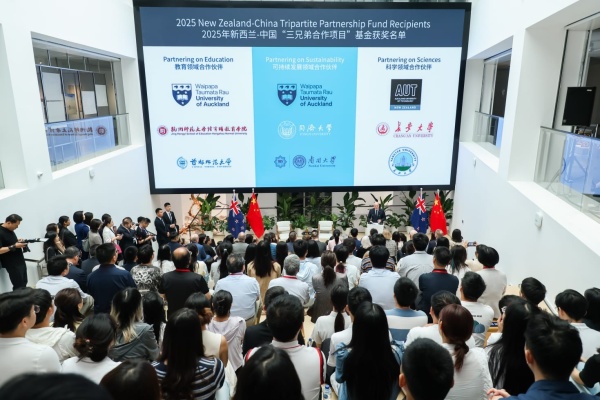
2025 marks 20 years of the New Zealand – China Tripartite Partnership Programme. Photo credit: New Zealand Trade & Enterprise.
ENZ congratulates the following researchers whose projects exemplify the high-quality research collaboration between our two countries:
-
Dr Fiona Ell (University of Auckland): Working with Hangzhou Normal University and Capital Normal University to enhance mathematics and science teacher education through comparative studies and exchanges.
-
Dr Sihong Wu (University of Auckland): Partnering with Tongji and Nankai Universities on sustainable production and carbon neutrality in manufacturing joint ventures.
-
Dr Yiming Ma (Auckland University of Technology): Collaborating with Chang’an and Yangtze Universities to explore mechanisms behind silent earthquakes.
Dr Fiona Ell said she is looking forward to working with her Chinese research partners to enhance mathematics and science teacher preparation, an important focus for education systems in both New Zealand and China.
“Our study brings together teacher educators from two Chinese universities, and teacher educators at the University of Auckland to exchange ideas and techniques for mathematics and science teacher preparation. The Tripartite grant allows us to visit each other, see teacher education practices in each country and compare policy directions in teacher education,” she said.
This will enhance the understanding and skills of all participants and help us find ways to improve mathematics and science teacher education in both countries,” Dr Ell added.
The Tripartite Fund, managed by ENZ in collaboration with several government agencies, supports strategic research partnerships between one New Zealand and two Chinese universities. The programme celebrates its 20th anniversary in 2025.
Learn more about the Tripartite Partnership Fund here.

Professor Nic Smith, Vice-Chancellor Te Herenga Waka – Victoria University of Wellington exchanges a Memorandum of Understanding with Fudan University President, Li JIN. Photo credit: New Zealand Trade & Enterprise.
Another key part of the event was Victoria University of Wellington renewed an agreement with Fudan University to revitalise the relationship, achieve resumption of student flows, and pursue research cooperation in the areas of public health, bio-tech and climate science.
-
-
New Zealand commended for inclusivity and humanity at APAIE
A New Zealand delegation featuring all eight universities attended APAIE 2019 as part of a planned strategy to build New Zealand’s presence ahead of the 2021 conference which will be hosted in Auckland.
The 2019 conference, themed “Diversity and inclusivity in higher education”, attracted more than 2,500 delegates between 25-29 March.
Discussions centred around the role that international education could play to enable disparate cultures and communities to embrace diversity and difference.
This theme had particular resonance in the wake of the Christchurch terrorist attack, and New Zealand’s response earned high praise from University of Oxford-educated Her Majesty The Permaisuri (Queen Consort) of Johor, Raja Zarith Sofiah Binti Almarhum Sultan Idris. (Johor is a state in the south of the Malay Peninsula and shares maritime borders with Singapore and Indonesia.)
In her opening address of the conference, Raja Zarith Sofiah said: “While we at this conference speak about diversity and inclusivity as part of academic discussions and presentations, the New Zealand Prime Minister, Jacinda Ardern, and all New Zealanders, from students to biker groups, have shown what inclusivity truly means when it is more than just words and promises, but are acts of great kindness, acceptance and humanity.
“Indeed, the way that the schools and universities there showed their respect and empathy prove – beyond mere words – that the breadth and depth of diversity and inclusivity transcends all levels, giving everyone equal opportunities at being heard and being understood,” said Her Majesty.New Zealand’s 2021 conference theme is “Innovation for sustainable futures” and will focus on building links between APAIE and universities in the South Pacific region.
With 2,500 – 3,000 delegates and at least 300 exhibition booths, it is expected to be the largest international education event to be held in New Zealand to date. It will be held in Auckland at the New Zealand International Conference Centre (NZICC), which is currently under construction.
“Over the next couple of years, ENZ will work with the New Zealand sector to build our presence at the APAIE conference British Columbia in 2020, so that the 2021 conference delivers for our education providers and showcases the best of our international education sector to the world” said Grant McPherson, ENZ Chief Executive.
-
Korean college adds Auckland to curriculum
From 2019, 120 Korean tertiary students from the college will come to Auckland each year, attending either the Auckland Institute of Studies (AIS), Academics College Group (ACG) or Cornell. They will spend 12 months gaining practical experience in the region as part of their three-year training course.
Koguryeo College teaches a range of courses in aviation, food science, natural energy, engineering, tourism and hospitality.
Auckland Tourism, Events & Economic Development (ATEED) International Education Manager Henry Matthews says the new partnership arose after ATEED hosted a group of visiting principals from Korea earlier this year as part of a professional development programme.
“The principals were so impressed by the warm welcome, the high standard of education institutes and great Kiwi lifestyle, they suggested to the college that Auckland would be the ideal study destination,” he said.
“For Korean students, gaining international work and study experience can put them ahead of other candidates when they’re looking for employment after their studies.”
As part of the agreement, Koguryeo College will also offer two scholarships for New Zealand and international students based here to go to Korea, learn the language and take part in the college’s various training programmes.
Korea is the fourth largest market for the international education sector in New Zealand. Some 5,000 Korean students base themselves in Auckland, contributing $167 million a year to the region. This new agreement will deliver an additional $3.5 million per year to the regional economy.
